

|
|
|
|
|
VOLUME 26 • CHAPTER 3 • July 2026MemoirsThe first Campionette, the student newsletter, was published 109 years ago, on November 11, 1917. The first editor of the Campionette was Tom O'Connor, class of 1920. The last official issue was the one announcing the closing of the school in May 1975. Over the years, various classes have published special editions for their class reunions, some of which have been pretty extravagant.
Celebrating 26 Years!The Campion Forever Newsletter was first published by Aaron Huguenard, class of 1947, in December 2000 in the Inprivatum Campianum at Campion-Knights.org as a means for alumni and faculty to keep in touch and share life experiences. CampionForever.org began in October 2001. Tom Olson '72 became editor and publisher in July 2010 at the behest of Aaron prior to his passing. We've been trying to get memoirs from retired and not-so-retired Campion Jebbies for our newsletter for quite some time. We don't care if the memoirs are about when they went to Campion, taught at Campion, or just what they've done since leaving Campion. We just want to hear something from our mentors in the first person; perhaps words of wisdom learned while IHS; typically, we only get third-person accounts post mortem. Not to lay all the blame on the Jebbies, but why can't we get memoirs from more alumni, or what they've done since leaving Campion? Where are all those other authors and editors of the old 'ette"? While it has been a task getting people to submit articles, there are a few dedicated alumni and Jebbies who do regularly provide ideas for articles. This is a good thing; otherwise, I would have to conjure the 'Ghost of Joe Campion' for ideas more than I care to.
From Joe Williamson '72
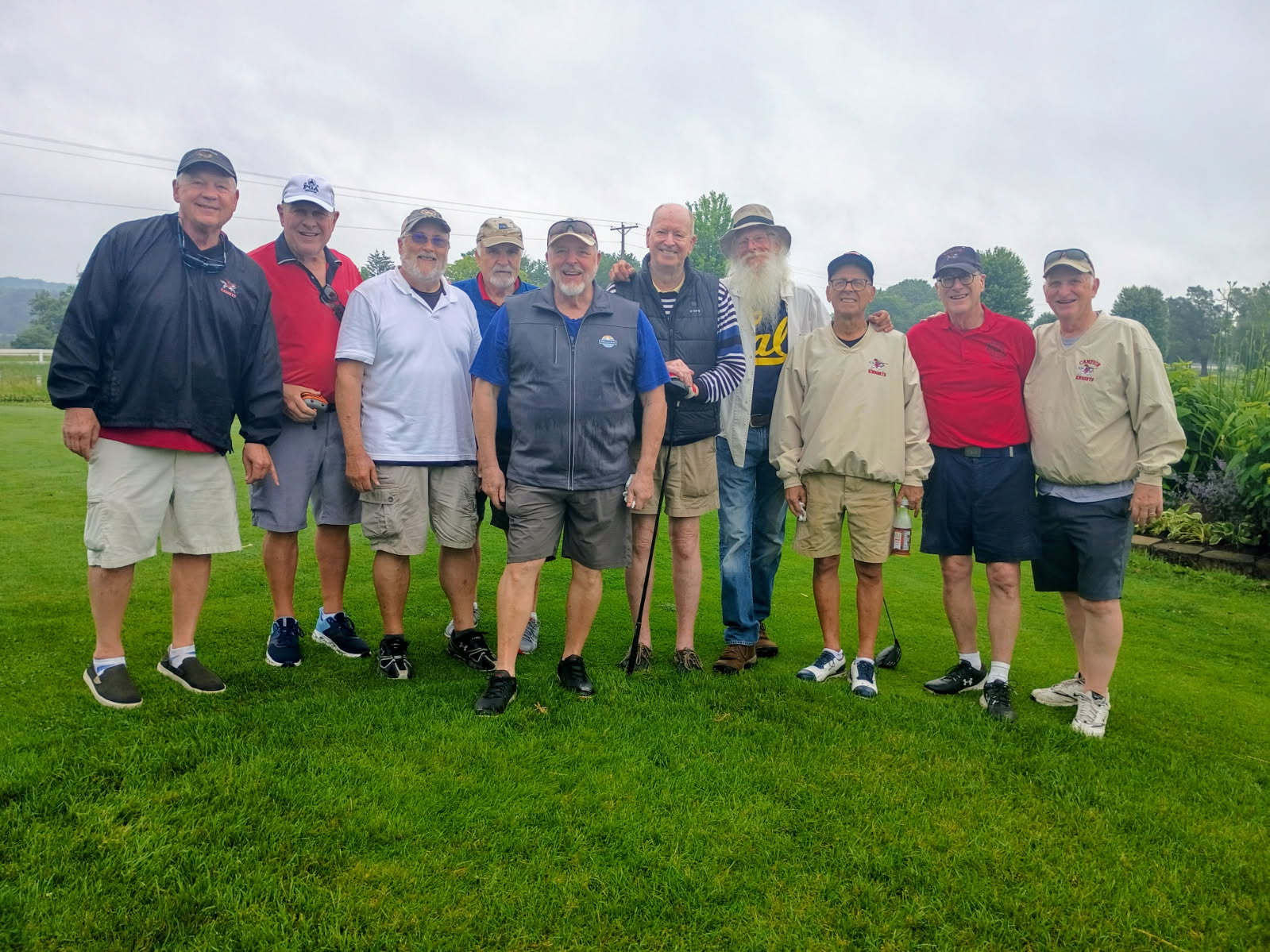
Report on Annual Golf Tour/All Class ReunionIt was a great time as always. Good turnout and we got 10 holes in before the rain chased us off. Some guys went back out and played but most quit. Always a great turnout at the Angus afterwards by all classes. Social hour and registration was at Eddies Irish Pub which is owned by Mark Peterson, class of 68’ who is also the organizer of the event. Here’s a couple of pictures I took. This is my brother and me along with class of 1970 guys.
From Bill Friedrichs '69
Hi Tom,
Regards!
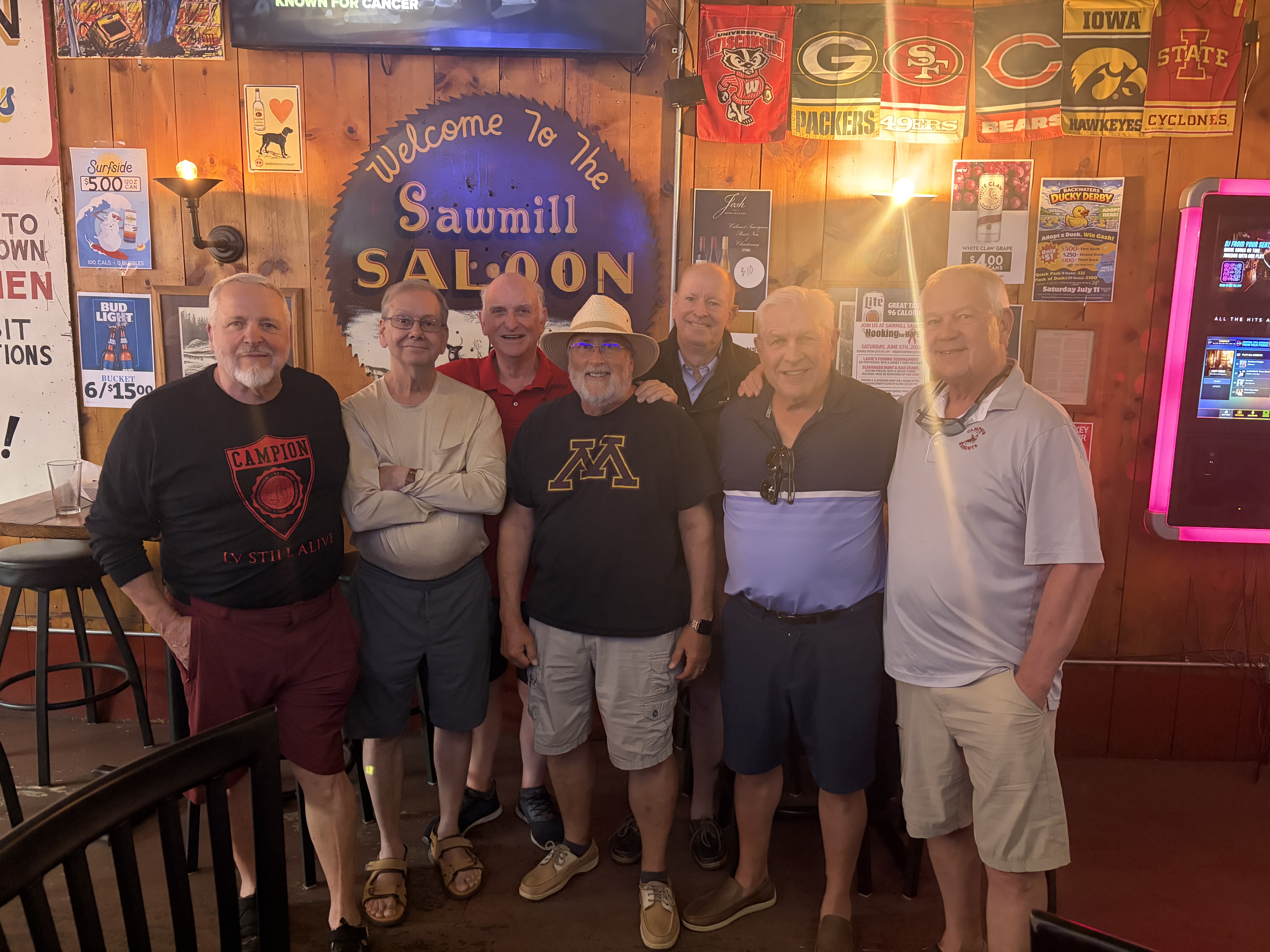
From Bob Smith '68 Tom - May I use your excellent newsletter to thank/salute Mssrs. Mark A and Thomas F. Peterson Esq. x 2, '68 x 2 for hosting the annual Campion Golf Outing for the past 31 years ? Each outing customarily is held in Prairie du Chien in early June. Non-golfers like me look forward to convivial conversation Sunday evenings before the Monday Outing. Robert Smith '68
From John McCormick '68
In August 1973, two summers before Campion closed, John McCormick ’68 was a reporter for the Dubuque (Iowa) Telegraph Herald. That August he attended an auction held behind Campion Hall to raise money for the school by offloading obsolete furnishings and equipment. A droll editor headlined this resulting column ‘Nostalgia Undersold’: PRAIRIE DU CHIEN, WIS. — Ladies and gentlemen, I will be patient about this. I will tell you of a two-day surplus auction at Campion Jesuit High School here. I will tell you how the sale of priceless artifacts mystified a grizzled veteran of the boarding school. And with the evidence presented I, the grizzled veteran, will ask you, the impartial readers, this question: Oh, what callous soul could sell the great Beany Mandis’ wooden wardrobe like so much furniture? The auction spurred recollections. Those leaden-looking desks, for example, came from a cavernous study hall where Tom Spicer catapulted into the freshman class presidency on a campaign pledge to secures real toilet paper to replace the harsher institutional variety. In their era those desks stood sentry for the dubious educational theory that wisdom would flow when 172 sniveling 14-year-olds perched daily at 172 work stations with piles of books before them. But try explaining heritage to a steely-eyed antique buyer barking with three other bidders and a staccato-style auctioneer. Thinking dollars, the auction types eyed trappings from the old infirmary. Since boarding schools weren’t blessed with “snow days” in winter, and since there are no mothers to fool with fake illnesses during the World Series, the infirmary had served a strategic function, particularly during class-action epidemics. One of these began when a couple dozen students contracted a flu-like sickness. Word leaked that the infirmary was up to its bedpans in flu victims, so new sufferers were excused from class and sent to rest in their rooms. With the infirmary ripe to be plucked, scores of wan-looking goldbrickers arrived. Salt shakers clandestinely circulated in the overflowing waiting room. Each new patient, hearing his named called for examination, dabbed salt beneath his tongue so the thermometer would register a few degrees above normal. The plot collapsed when a young Chicagoan with habits of wretched excess hiked his temperature beyond the point of death. Last week’s auction-goers didn’t even care about Ken Oakes, detained with some illness for endless days at the infirmary. Ken’s friends, bedeviled by spring fever one evening, concluded that their compatriot must have had his body snatched, and that an impostor might be issued in his place. Thus enraged, a detachment stormed the infirmary, banners waving, demanding that nurses surrender Ken’s corpse and assassinate the Hoax Oakes, should one exist. (The Real Oakes survived his stay in the infirmary, a bewildered little structure that now wears a sign reading “Sunny Day Play Skool.”) But in August of 1973, all that historical mischief was lost on the buyers as they trailed two auctioneers in snap-brimmed fedoras. The lot of them scavenged through mirrors and medicine cabinets that once had lined a hallway outside a dormitory nicknamed The Barn that housed 96 freshmen in wood-partitioned alcoves. Every morning for decades, 192 cold feet would trundle toward 96 hall sinks and those overhead medicine cabinets, each cabinet with a cheery little prayer pasted to the mirror. It did not take long to develop a distaste for the dorm, the floor, the sink and the prayer. Those auction types didn’t even slow down when they got to Tim McVary’s old dresser. McVary, no slouch for a 14-year-old, occasionally had clambered atop the dresser, then mounted the seven-foot-tall wooden alcove partitions when his 95 roommates were asleep. Not unlike medieval warriors who poured vats of boiling oil to defend their fortress battlements against attackers, McVary would uncork a plastic canister that made whooshing sounds as it rained down clouds of foul foot powder on the unsuspecting babes. Victims awoke with a malady approaching black lung disease, as the powder smelled worse than any foot. At the auction, crowds swelled around two rows of wooden wardrobes hauled from The Barn when it was converted to a science complex. Most of the wardrobes looked fairly plain, although one wore an old Ottto Kerner political sticker, and on another, a lad presumably named Irvin Pfab had stamped the name “Irvin Pfab” in ink at 11 locations. But inside the doors, inscribed hieroglyphs told of sporting contests with Loras Academy, undying romances with girls from towns such as Wonewoc,l Wis., and other high school milestones. One wardrobe had been autographed by “E. Bartl, Nov. 10, 1898.” Another carried signatures of 78 students who had entrusted life’s belongings to the wardrobe before it was decommissioned. And there, not quite in line with the others, stood Beany’s wardrobe, with the name Mandis authoritatively marked above the door. An American reared in Saudi Arabia, Mandis earned our immediate respect, having bought Rolling Stones albums in Great Britain. Beany’s wardrobe went early at the auction. Buyers swarmed around other items: Aged bowling balls and wooden snow skis; 640 divided metal food trays; a snow blower; old trunks and suitcases abandoned by their owners; a dining hall rack with slots for “forks, knives, spoons, spoons, knives, forks”; one Bonanza hand-Operated Apple Peeler. Another fossilized alumnus grumbled his pleasure that 85-year-old Kostka Hall had the decency to burn down a few years ago, lest its innards be dragged before the ravenous auction crowds. That building took with it photographs of some prior graduating classes. Which was probably just as well; one hears that students today have more important tasks than worrying about the Hoax Oakes or Tim McVary, foot powder bombardier. What the auction took may never be missed. And as one Jesuit noted, the auction proceeds will help slap on a new roof or some coats of paint where they’re needed. Still, what callous soul could sell the great Beany Mandis’ wooden wardrobe like so much furniture? ###
From John Huarykiewicz '63
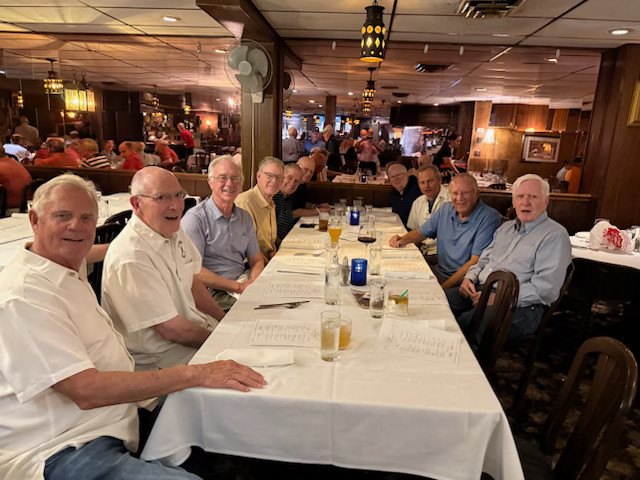
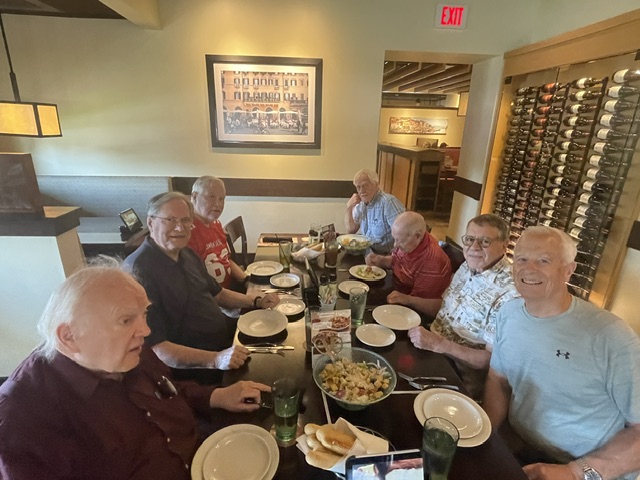
On June 9, 2026 seven Knights met for lunch in Minnetonka Minnesota. John Duskey 63 extended his trip from hometown Crete outside Chicago via Prairie du Chien. Jim Favre 63 came from Rochester, MN. The rest are Twin Cities (regional) residents. No infractions worthy of JUG were observed
From Ghost of Joe Campion
Flashback in the ethers. Explain this phrase! - "Prairie du Chien Green; Always Wild, Always Mild"
From the desk of John Duskey '63 Recollections, Transitions. Music and Popular Poetry July 2026 The year 1963 was a year of transition in the world of popular music. It was the last year before the “British Invasion” brought us a whole new sound, new musicians, and things were different after that. It was a whole new world in the political arena, with the death of our president, which led us into a time marked by the war in Vietnam, and the decisions that led us to a new era in national finances. For me and my classmates, it was the year of transition from Campion High School to college life, which for many of us meant a transition to life in the city, when we had previously known the calm, simple life in Prairie du Chien. I have chosen ten works of art that I, and many others, experienced during that year. I did not include the British Invasion. I did include some songs that had a real message in the very title. As with many other years, there were some songs that were very close to nonsense, and some that had a very simple story to tell. I tended to avoid those. Later in the sixties, there were protest songs: protest against the Vietnam War, and against things that seemed to be going wrong in society. In 1969, a song was written that was a protest against the high school curriculum—which the songwriter held for release until May 1973, so that it would hit the juke boxes and radio stations just in time for the tenth anniversary reunion of our class. In general, the late sixties gave us songs that told a story for a later time in history. January of 1963 was the month when Bobby Vee told us “the night has a thousand eyes.” It was a warning that whatever was thought to be secret will eventually become known, a statement that was included, with different wording, in the Bible. If you have an interest in film, you might look up the 1948 film that bears this same name. In March, the Rooftop Singers came out with “Walk Right In.” This had particular meaning for me, as I was, like my classmates, starting to go through a transition to a different kind of life. During the evening study hall break I would go down to Kevin Neylan’s room in Marquette Hall and walk right in, just as the song says. Kevin was not obliged to, but he was willing to play basketball on the C-league intramural basketball team, of which I was the captain. Though I held that title, the championship was really won by John Augustine, Dan Nillen, Tom Scuderi, and Kevin. I think people knew that I had virtually no athletic skills. In recent years I had tried to get together with Kevin at the June reunion, as he lived in Garnavillo, Iowa. However he felt unable to join us. I was truly saddened to learn of his death last December 18. About this time Leslie Gore came out with “It’s my party and I’ll cry if I want to” which had no significance to me until a few days before our graduation. I was at a party celebrating our graduation, in Loyola Hall, and in a conversation with classmate Neal Shannon. I noted that we were being released from the rules and obligations of the last four years. Neal responded, as he was smoking a cigarette, “It’s my party and I’ll smoke if I want to.” I had never spent much time with Neal, not that I didn’t want to. There just wasn’t enough spare time. I had hoped to reconnect with him at a later reunion, but Neal died before that could happen. Around the time of our graduation, one could regularly hear “Pipeline” by the Chantays. One of the great examples of that guitar-instrumental genre. Stories about this resonate in many places, but it was most remarkable that these five young men, just out of high school, appeared in May, 1963, on the Lawrence Welk show. Now, in case you don’t remember, in the early days of television it was common for networks to air hour-long shows featuring bands like those that were popular in the forties and fifties. Welk had an impressive following and his show stayed on the air, network and syndication, until 1982. Given the cultural differences, there is no way the Chantays would have appeared on Welk’s show except that they impressed Welk as being fine young gentlemen. (I can mention that I had been a regular viewer in my pre-Campion years.) I should also mention here that Pipeline was among the pieces regularly performed by the Crossfires, a group of musicians from Campion who performed at several of our functions, and elsewhere, in the mid sixties (John Haurykiewicz, Bill Kestell, John Augustine, Jerry Noel from ‘63 and Ted Swartz ‘64). There are several photos of them, and the rest of the story, on the Campion-Knights.org website. In the summer, a group called Essex had a hit record with “Easier Said than Done.” This group had no time for public appearances or concert tours. They were United States Marines, all on active duty. There are pictures of them on-line, all dressed in their Marine uniforms. The statement made by the song’s title is fundamentally true, and can be applied to many different situations. This song can also be interpreted as a tribute to the U.S.Marines. I was not working as many hours that summer as I had worked in my father’s factory in the previous two summers, so I had time to play golf (without much success) and do some work in the back yard at our family’s recently purchased house in Crete (where I still live). I also made a trip to Milwaukee to find out what it would be like to live in that city, and also to see the Fr. Walsh/Marquette University version of the play “Oliver Twist.” This was similar to the version we performed at Campion in May 1963. (For more about the Campion presentation of Oliver Twist, see the July 2015 issue of Campion Forever.) Two songs that I remember being on the radio that summer were “Denise” by Randy and the Rainbows, and “So Much in Love” by the Tymes. I think I have written more than enough about how much I enjoyed that trip and the city of Milwaukee. In October, we were treated to the “wall of sound” as a musical device, by the Ronettes in “Be My Baby.” It is one of the most remembered songs of that era. Another musical composition I particularly remember was the Village Stompers version of “Washington Square. That song was on the radio when I traveled with the Marquette University Debate team to a meet at University of Chicago in early November. The debating experience was successful. I left the debate team in mid-sophomore year because there were some things I had to do in Band that nobody else was going to do. In those days, Marquette required all students to go on a spiritual retreat. We had a closed retreat at St. Bonafacius, Minnesota in spring 1963, during our senior year at Campion. In Fall 1963 I was able to go on a closed retreat at the Jesuit Retreat House in Oshkosh the weekend of November 21-24. On Thursday evening and Friday morning, our retreat master, Fr. John Naus, told us that anyone could die at any time, that we need to be ready. We had time to eat lunch and rest before we reassembled for our afternoon session. You know the rest. In those days, the Marquette Concert Band was rehearsing to play the Finale from Dvorak’s New World Symphony at our December concert. I have, since that time, associated the events of November with the New World Symphony. The joy from earlier that year was gone. The British Invasion and the Vietnam War were in the future. I remember visiting my grandmother and hearing about the McKinley assassination—there was no TV, no radio, just the sound of paper boys selling “Extra Editions” with the news. December 1963 seemed to be an empty month, as though a whole lot of life had been lost. ================= Following is a list of youtube videos for all the music mentioned here. Most of them are two to three minutes long, but the New World Finale is more like 12 minutes. I tried to choose versions that showed active singing, not just album covers. I tried to choose color, because, as I once said, everything looks worse in black-and-white. Yet I provided the Chantays monochrome version of Pipeline where Mr. Welk introduced them and the members were individually named. It seemed that Mr. Welk told them exactly what to say.
1,  The night has a thousand eyes, Bobby Vee
https://www.youtube.com/watch?v=3GQAmTznY2o&list=RD3GQAmTznY2o&start_radio=1

2.  Walk Rignt In, the Rooftop Singers
https://www.youtube.com/watch?v=Ny6MScdJM_s&list=RDNy6MScdJM_s&start_radio=1

3,  It’s my party and I’ll cry if I want to, Leslie Gore
https://www.youtube.com/watch?v=VzVJdhuAxrk&list=RDVzVJdhuAxrk&start_radio=1

4. Pipeline, the Chantays
https://www.youtube.com/watch?v=ZFucCXherLg&list=RDZFucCXherLg&start_radio=1

5,  Easier said than done, the Essex
https://www.youtube.com/watch?v=YzykL5ot18o&list=RDYzykL5ot18o&start_radio=1

6.  Denise, Randy and the Rainbows
https://www.youtube.com/watch?v=v1RwciS3Cnc&list=RDv1RwciS3Cnc&start_radio=1

7.  So Much in Love, the Tymes
https://www.youtube.com/watch?v=z5D8XoP8mhM&list=RDz5D8XoP8mhM&start_radio=1

8.  Be My Baby, the Ronettes
https://www.youtube.com/watch?v=McsOvNXIMbw&list=RDMcsOvNXIMbw&start_radio=1

9 Washington Square, the Villlage Stompers
https://www.youtube.com/watch?v=E5A03qWZFrM&list=RDE5A03qWZFrM&start_radio=1

10, Finale from the New World Symphony, Dvorak,
https://www.youtube.com/watch?v=jVDofBFtvwA&list=RDjVDofBFtvwA&start_radio=1
|
|
|
|
|
|

 Obituaries: